Teaching: A Love Story
“I've learned that people will forget what you said, people will forget what you did, but people will never forget how you made them feel.” ―Maya Angelou
Teaching is a privilege like aging but, like aging, it is not for the faint of heart. Last week, at the start of a new adult writing class I was waiting for my students to arrive when the door opened and a young man and an older woman entered, the young man clearly agitated, hitting himself, and making noises that were, honestly, very like a wounded animal. In short order I discovered his companion was his aide and she was extremely reluctant to provide me with any information about her charge except to state he was a genius and a writer. I had yet to meet any of my students and wondered how I was going to manage to help/teach/contain this person while providing attention and information to the rest. Somehow, with the help of my kind students, this person calming down, and my own experience with crazy situations, we managed.
On 9/11 I was standing in front of my junior honors class teaching Macbeth when the door burst open and another teacher was standing there, wild-eyed, and said: “They’re attacking New York.” While we sometimes knock on another classroom’s door to ask a question or borrow something, having another teacher broach the sanctuary of your classroom was, to put it mildly, unexpected. I tried to lower the tension.
Me: “Oh, they’re always attacking New York, Ms. Baker.” We were in Evanston, Illinois, a suburb of Chicago.
Her: “No! They’re attacking New York with planes. The World Trade Center is on fire. People are jumping.”
I had gotten engaged in the World Trade Center Winter Garden after living in New York City for thirteen years. Many of my friends lived there. “Okay.” I looked at my class of near adults. They looked freaked out. “Let me just see what’s happening,” I said. I crossed the hallway and stood with several security guards and other adults as another plane hit the building. And then I went back. I knew it was essential to be as calm as possible, but I also felt completely unhinged by witnessing this event. They were waiting for me. Some students were crying already. I told them the little I knew, asked them to stay quiet but also did not go back to teaching them a play about a mass murderer. The compartment where I kept my anxiety and grief was firmly shut. I would not allow myself to feel until the school day was over.
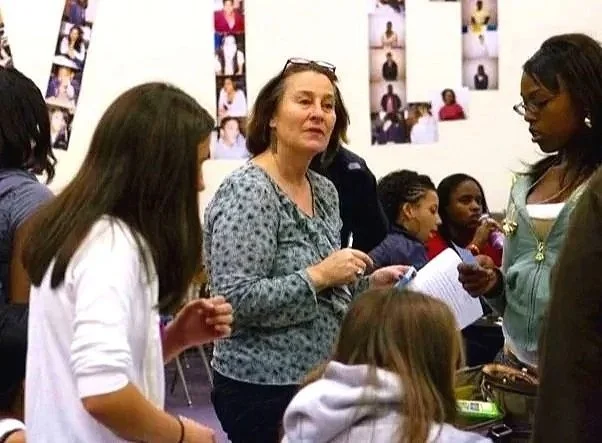
Molly Moynahan in the classroom, helping writers find their voice.
Previous to this job I took over a class in a very ganged-up Chicago Public School after the usual teacher was unable to leave her apartment because of snow and her own severe MS. When I arrived in their classroom, the gang members, members of rival gangs, mind you, told me they were not “regular” students, they ran their own “crew”, and they “took care” of the previous teacher so she allowed them to do anything they needed to do to keep their gang life working. I made them read Jane Eyre. I assigned short writing exercises and covered their papers with stickers and positive comments. We took down the pictures of various naked-ish women and put the desks in order. I stood at the door and thanked them for coming, thanked them for staying, told them I looked forward to their return. They returned. They read most of the curriculum and started raising their hands. When a student was arrested out of my class for armed robbery, I ran after him with a copy of The Pearl and told him to read it. “Why did it take you so long to find us?” One of my female Bosnian refugee girls asked. They bought me a cake for my birthday and they sang to me.
I taught a class in the Bronx on the day Rodney King’s attackers, Los Angeles Police, were all found innocent of police brutality. As I walked down the only main street towards the school, I realized I was being watched, that I was being followed, that I was hearing comments about my whiteness, and also about the fact I was about to be attacked. I had a rare insight about how it could feel to be a minority in a hostile environment. Suddenly I felt an arm around me and one of my students, an older black woman, was walking next to me telling the black men who were following me to stop because, “She is my teacher and she is a good person.” When we reached the classroom I faced the students, a dozen older black women, and listened as they described being ignored in restaurants, harassed by law enforcement, and denied housing. They were angry but they also told me how good they felt in my classroom and several volunteered to walk me to the subway so I could avoid the previous gauntlet.
What makes one a good teacher? I’m not sure but I think the ability to think on one’s feet, to actually love, not like, your students, to have deep knowledge of your subject, and to be willing to look wrong, stupid, sad, and angry, to be human in front of people who may or may not hate you, is a good start. You need a sense of humor and a sense of perspective.
When you discover the reason your student has missed several classes is because his father has locked him in the cellar, you need to find someone to save that student. When your Mennonite girl tells you she is gay and that middle school was the worst time of her entire life, you need to be willing to ask her other English teacher to give her an alternate assignment than a memoir. When that teacher refuses you need to tell that girl to make things up, to weave a fairy story of her life and to know that someday she will have a chosen family and life will get better. When a college student writes a “story” that is clearly about him and his love of heroin, you need to break the fourth wall and tell him you are sober and you’d like to help him. When a writing student allows the class to know he is dying, consider the honor.
Before the recent class ended the boy who could not speak made insightful and helpful comments on the work of others. His computer read his comments aloud and we were no longer wondering whether he belonged.
Molly Moynahan