The Seven Deadly Sins and Me
“Proud people breed sad sorrows for themselves.” ―Emily Brontë
I am chronically discontent. Set a goal, draw a line in the sand, set a bar, articulate a dream, an intent, an aspiration, and I will get there and immediately embrace some version of failure. Here are some of the things I’ve achieved, a master’s degree in writing, four published novels, a marriage lasting into the third decade, a healthy, happy adult child, a sulky but secretly content cat, several houses, the ability to swim over a mile, a full-distance triathlon, bicycling over seventy miles a day for six days, wonderful friends, over forty years of continuous sobriety. Guess what? It’s all slightly flawed, not quite perfect, shadowed by an overwhelming feeling that while I am fully aware, the life I inhabit is privileged and, at times, extraordinary, there is that pea under the mattress I can’t avoid, the slight flaw in the dream, the cloud in this sky where I live in such aching beauty here in Northern Michigan.
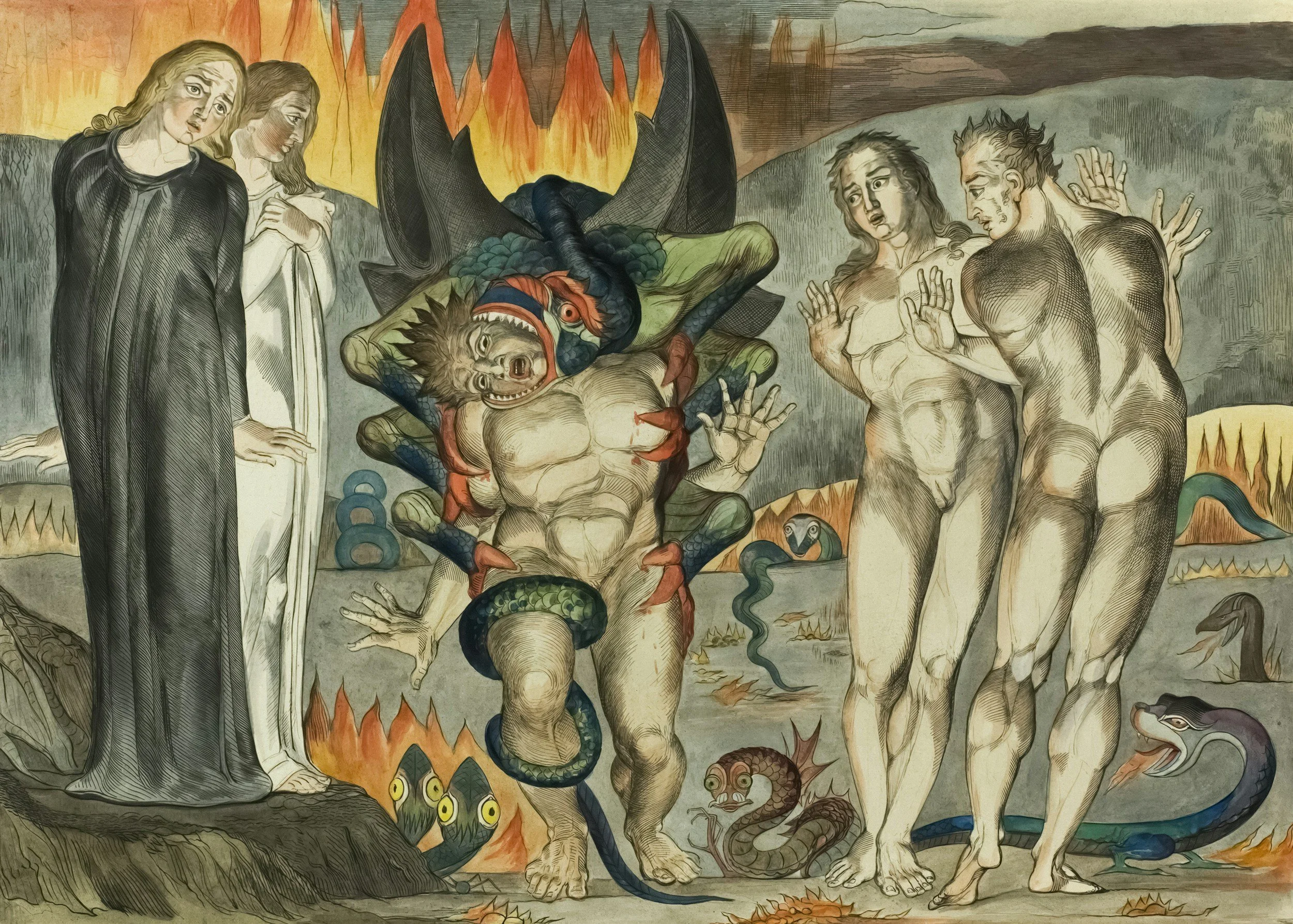
William Blake, The Circle of the Thieves, 1827. Hand-colored engraving illustrating Dante’s Inferno, Canto XXV. Collection of the Art Institute of Chicago.
I’d like to attribute this lack of gratitude, this constant sense of having been given the smallest piece to being Irish American with all that history of fracture and famine and priests behaving badly but really, I was born and raised in New Jersey, and while my parents constantly invoked the Irish thing, it really wasn’t my thing and maybe wasn’t their thing after all. It was my grandmother’s thing, born in the north of Ireland, raised in a convent, a hint of a brogue, a survivor of WWI, a part of the Florence Nightingale sisterhood of nurses, where she was in combat, gassed, and traversed France with a priest in tow, converting dying soldiers to Catholicism.
I was raised as a heathen. My nickname in the Christian Science camp where my parents dumped myself and my sister while they swanned off to Europe was “the poor little girl who doesn’t believe in God.” This was not accurate. I believed God didn’t exist, which was what I said to our camp counselor, a chubby girl named Debbie, when she asked whether I wanted to say my prayers in silence or aloud. I knew this because my parents said so. I also knew this because my father wouldn’t stop drinking and hurting my mother, my oldest sister took drugs, our handyman shot himself in the head, our cats kept getting run over, and a girl I really liked, my only friend in eighth grade, was run over by a car and died. Also, there was Vietnam, multiple assassinations, horrible mass murders, babies who died of starvation, and racism. This was enough proof that I lived in a world that lacked any spiritual anchor.
And then there is the pride thing. Pride is defined by Catholic tradition as “excessive love of one’s own excellence.” This is a revelation. When I’m asked whether I’m proud of my sobriety, my writing, my mothering, my athletic discipline, it is probably not a sin to admit to this feeling. But it’s definitely better to have humility and pretend you are indifferent to your excellence, which might be a lie—but there you are. Lying is not on the deadly sins list.
Gluttony and envy, however, are on that list, and I’ll willingly admit both are part of my daily reality, along with being judgmental and rigid. Which I blame on those long-dead and probably innocent Irish ancestors.
Molly Moynahan