The First Heartbreak: A New England Bicycle Odyssey
“There is no despair so absolute as that which comes with the first moments of our first great sorrow.” – George Eliot
Cindy and I perfected our plan to go bicycling with an American Youth Hostel group all over New England for six weeks. Never mind that neither of us had any real talent for riding bikes or interest in canoeing or hiking which this trip also offered. It would be six weeks without our parents, with each other, six weeks of freedom, albeit requiring that we ride a bicycle loaded with forty pounds of gear, upwards of eighty miles a day, through the mountains of New Hampshire. Cindy told her parents my parents had agreed to let me go and I told my parents her parents had given her permission, we both lied about the amount of adult supervision, we both confessed to a secret passion for long distance bicycle riding and both of us asked for ten speed Peugeots for our respective birthdays.
Sometime after school ended a Winnebago pulled into our driveway and Cindy, her bike, her parents, her aunt and uncle, and a few cousins tumbled out. Her parents thought my parents knew everything about the trip; my parents had once left us in a Christian Science camp. After a few days of telling lies, both sets of parents thought we were ready to ride our bikes through New England.
Cindy had grown up. She was taller, slender; her legs were very long and slim. She wore cutoff shorts and a t-shirt and everywhere you looked there was smooth, white skin, blue eyes, blonde hair, and high cheekbones. I had my braces removed that May, my hair was down below my shoulders, the baby fat had disappeared, my face had slimmed out, the cheekbones and green eyes made it hard for me to recognize my inside, unhappy self.
We went inside the American Youth Hostel building. The building was old and beautiful with a soaring roof, I looked up and saw a man standing on the balcony, not a boy, but a man, with curly brown hair and a handsome face. Our eyes locked. The meeting was held in a room off the hallway. There were ten chairs arranged in a circle, most of which were already occupied by other kids, kids that looked younger than us on the whole; two other girls and six boys, the boys that strange adolescent mix of almost a man to someone who appeared the age of a kid I’d babysit. Most of the other kids were from the New York area, the two girls from Brooklyn with accents like ground glass, one pretty fat (Debbie) while the other one was very skinny (Donna). The boys were not memorable but they seemed okay, one guy was a bike racer and had enormous calves. Our leader’s name was Paul, he had been in the Hell’s Angels for several years, he was a Vietnam vet and if any of our parents had attended that meeting, no one would have allowed a person who looked and spoke like him to have authority of ten adolescents for six weeks. But it was the early seventies; our parents were shell-shocked by the war, the assassinations, the sexual revolution, and their college age kids acting out. We were on our own.
After Paul introduced himself and said “motherfucker” six times, he announced we would have a different leader during the time we were hiking and canoeing. “The thing is, chickadees, I’m not like this expert at hiking so this bad ass motherfucker, Mitchell, will be our fearless leader, he’ll take us up to the White Mountains and on the Androscoggin River. Here he is.”
The man from the balcony appeared and the two girls from Brooklyn squealed. “He’s so cute,” they said loudly. Mitchell was staring at me. Cindy dug her elbow into my rib. “He’s staring at you,” she whispered. “I know,” I said. “Why?” “I saw him before.” “When?” “On the balcony.” “What balcony?” I didn’t answer. Mitchell was the dark man from my dreams, the secret agent, and the person who understood me without my having to say anything.
“What’s your name?” Mitchell asked. “Molly.” I said. “You ever gone backpacking before?” I shook my head. “I think you’ll like it,” he said. “I love you,” I thought. The bus pulled away from the front of the hostel building without Paul even though we were all telling the driver that our leader was missing. As it slowly rolled down Fifth Avenue we heard someone shouting, the word “motherfucker” audible. At the light, the door opened and Paul got on wearing a wife beater t-shirt, tattoos covering his arms, jeans, and biker boots and chains. “Hey,” he bellowed, “I got the fucking bagels. You gonna leave me behind? Huh?”
He came down the aisle handing people bagels and stopped to leer down at Cindy and I. “Look at you two,” he said. “Like something from a fairy tale, so pretty and so different.” I glared up at him. “Hey,” he said. ”I’m just admiring the beauty. Old Paul isn’t gonna try anything.” It was five o’clock in the morning so we curled up and went to sleep. Seven hours later the bus pulled away from a deserted New Hampshire road leaving ten adolescents, ten loaded ten speeds and a man who looked like he was the titular head of the Hell’s Angels in its dust. Paul pulled out a map and then pointed at the small mountain in front of us. “It’s that-away,” he said. “We got six hours of hardcore mountain terrain in front of us.” Debbie started bawling and telling us she wanted to go back to Brooklyn. The guy with the long hair got on his bike and looked back at us. “Come on,” he said, as if we were an army he was leading into battle, “We can do this.” Geronimo turned out to be a professional bike mechanic, a racer, the only thing that lay between constant disaster and us. We were out of shape, did not know a single thing about how to shift gears, pedal, change a flat or, in Debbie’s case, manage to keep moving for more than ten minutes or so without getting off our bike and wailing about going home.
After several hours of pedaling, Cindy and I found ourselves alone in the middle of the pack, Geronimo and two of the fitter boys were in front, the rest were behind, visible because we were riding up steep hills and then swooshing down them again, our rear tires weighed down with tents, cooking utensils, and other gear, helping the velocity of the downward journey to reach astonishing speeds, our helmetless heads with hair blown back, our inexperienced fingers hovering over what we hoped would turn out to be the brakes, our legs pumping frantically at the base of the ride since we barely understood the rudiments of shifting gears. “Oh my gosh,” Cindy shouted as we strained to get up yet another steeply graded hill, “We’re free!” She stuck her impossibly long legs out and screamed “No parents for six weeks!”
It would be longer for me. After this trip I would board a bus to Maine to spend August babysitting my New York literary icon’s wonderful boy. It wasn’t a bad thing to not go home. My oldest sister had returned from school at the beginning of the summer with a long-haired, annoying, rich kid boyfriend and they both seemed perfectly comfortable fucking, eating and fighting, smoking dope, and drinking my parent’s booze, without worrying about contributing to the household. This boyfriend had lectured all of us on his deep commitment to vegetarianism but when my sister refused to give him a pair of perfectly broken-in jeans, he had offered to eat a cheeseburger.
At four that afternoon, Cindy and I reached the crossroads where the campsite’s entrance was and Geronimo and Sam, a Long Island boy who would develop a huge crush on Cindy were standing there, in between lay a bicycle, Paul’s bicycle. Paul had fallen off his bicycle and been taken away in an ambulance. “He said we should put up the tents and he’d be back,” Sam said. “The guy’s crazy.” We waited for everyone else to arrive and then slowly cycled the remaining five miles almost entirely uphill. Somehow we had become united, a parentless group of adolescents who were hungry enough to eat raw spaghetti. However, I knew how to cook. Years of helping my mother had made me capable of cooking almost anything, which was fortunate, as none of the other kids even knew it was necessary to boil water before cooking pasta. They were completely helpless except for Geronimo who could fix bicycles, Sam who could start fires and Larry who had some experience putting up a tent. The rest were from Brooklyn, spoiled Jewish kids except for Cindy who was from Ohio but had no survival skills.
By offering to cook that first dinner in the dark I became the symbolic mother of a dysfunctional family. The others clustered around while I stirred the pasta asking when it would be finished, overly impressed with my throwing in chopped up cheese and ham, a few spices we found in Paul’s pack along with a huge knife and a flask of whiskey. Like children afraid of their father we poured his whiskey into the forest floor and threw the flask away. Paul was bad enough, but drunken Paul would be terrifying. After dinner we put our sleeping bags near the fire, in a circle, close to one another. We had no idea where Paul was or whether we would be allowed to continue on our trip. “This is like the only time I’ve ever been away from my family,” Debbie said. “And now we’re going to get eaten by bears.” The sky above us stretched out, a midnight blue cloak covered in diamonds. “I’m so happy,” Cindy whispered. “Maybe you can lead the trip.” “Right,” I said. “Me and Geronimo will take care of all of you. We don’t even know where to go tomorrow.” Finally, we fell asleep.
Hours into the night I woke up to the sound of someone shouting my name in the dark, “Molly, Molly baby?” the voice, a deep man’s voice said. “Where are you?” I nudged Cindy awake. “Oh my gosh,” she said, “Why is he calling your name?” Suddenly, we heard branches breaking, the sound of something big crashing through the bushes. “It’s the bear,” Debbie screamed. “We’re going to die!” Then there was a flashlight and Paul; Paul with his arm in a sling accompanied by a woman, his nurse from the emergency room who apparently thought he was kidding when he told her about us. “Jesus fucking Christ,” she said, “kids.” “Babes in the woods,” Paul roared, clearly stoned on painkillers, “my little band of bikers.” Paul and his nurse disappeared into another part of the woods and we fell back asleep, too exhausted to worry.
The next day we were told by Paul that even though he had sustained a broken collarbone he felt committed to staying with us. “You’re my kids,” he told us, trying and failing to look fatherly. “Where’s the nurse?” Debbi asked, yawning. Paul looked embarrassed. “She’s gone home,” he said. “Is she your girlfriend?” John, a kid with a Jewish afro asked. “No,” Paul said. “She was being a good Samaritan.” “He picked her up in the emergency room,” Geronimo said. “Who’s gonna take your stuff?” We all took his stuff. We divided it up between us, increasing the weight on our back tires. Paul rode with one hand, the other arm immobilized in a sling, singing at the top of his lungs. Because of his crazy looks and the sling, people kept reporting someone who resembled a pirate with a bunch of underage kids. The police followed us into small New England towns and visited our campsites where I was inevitably making dinner while Cindy flirted with the boys, the Brooklyn girls complained and Geronimo checked over our bikes. The meals I cooked were mainly one pot wonders; rice and meat and tomato sauce and vegetables dumped into a pot and heated up enough to make it edible. We were starving, biking an average of seventy miles a day, never really getting enough to eat. Because of Paul we went slowly, trying to keep him between us. We kept arriving at the campsites after dark, putting up the tents and starting dinner in the dark. It was chaotic and crazy but we were fifteen and no one told us when to go to bed or to eat our vegetables or to stop swearing. When we did laundry we took off all our clothes and walked around in our rain ponchos.
One day Cindy and I went to look for socks in an old fashioned Maine department store. Neither of us had taken a shower for a few days, we were dressed in cutoff jeans and sleeveless t-shirts, our sun streaked hair tangled down our backs. The saleswoman kept following us around, probably fearing we would steal something or get something dirty. Our legs were tattooed with bike grease and I was wearing an extra bike lock around my waist. Finally, we stopped in front of a full length mirror and saw what the truckers and the men beeping their horns saw, two young women who looked like Amazons, our legs and arms were muscled, our faces tanned and thin, we both looked older. “Oh my God,” Cindy said, “Look at us!” I had become my dream, thin, tanned, and almost blonde. I looked much older, like someone 007 might have tried to pick up. A woman rising out of the water in a white bikini, a knife strapped to her hip. “You’re so sexy,” Cindy said, smiling. “You look like a movie star.” Then the lady who had been giving us dirty looks finally walked over and after giving us a long hard stare said, “You girls ought to be ashamed of yourselves.”
But we weren’t. Cindy was gorgeous but I didn’t tell her because I was jealous and stingy with praise, while she loved completely and didn’t save parts of herself out of fear. Perhaps this famine mentality had been bred in my bones, the Irish ability to criticize and belittle, my grandmother had dozens of put-downs, built like a brick shithouse, face like a foot, we were sharp with our criticisms, slow with compliments. Now I understood the looks we had been getting from Paul, the shouts from the cars that passed us on the road, the men who were beginning to turn around, to stare and comment. I could feel the power of this effect but I also felt threatened and sad. I had a childhood marked by physical freedom, the freedom to climb trees, run, explore the fields and barns behind our house. The boys at school had seemed like playmates, even the few who had confessed to having a crush on me, I had ignored or slapped or made fun of them so they had pursued a different girl or remained lovesick. I was no longer sure I wanted to be sexy. The way most men acted around me was creepy, their hands lingering in my palm when they gave change, their tone of voice too intimate, their concern tinged with desire. Age didn’t seem to matter. Men old enough to be my father or even older leered at me while boys my age stuttered and blushed. There was a new nervous energy that didn’t feel right. I had never had a sex talk with my mother or sisters. Somehow it was assumed I knew what I needed to know, understood what I needed to understand. But the truth was, I neither knew nor understood anything. I had never seen a man naked; boys were a complete mystery to me. In Women in Love the two female characters, Gudrun and Ursula represented the carnal and the pure, the predator and the parasite.
I had this very literary, very psychologically deep idea about sex which didn’t help at all when Paul told me I had a great ass or some stranger on the road pulled over to beg me to have sex with him. I had spent so much time reading about sex and love. I was an idiot savant in the world of men and women. I read pornography and Wuthering Heights; a woman had a “zipless fuck” as Erica Jong would call it in Fear of Flying, or she would be so beautiful and wild that after she died Heathcliff would wander the moors calling her name unable to exist without her. Cindy, on the other hand, had been dating her boyfriend for nearly two years, had almost gone all the way with him but held off and was expert, according to her, at French kissing. She described long make-out sessions in his car while I was imagining the Highwayman galloping across the bridge, The Phantom, swinging through the jungle, 007 cutting the straps of my gown with a stiletto, Jean Paul Belmondo whispering sexy French secrets, George Harrison writing me a song, Illya Kuryakin holding me in his arms even though I was a Russian double agent or starring in a movie like Doctor Zhivago wearing a full length fur coat and great boots. It was all mood music, clothes, settings, gestures and poetry. I wrote in my journal: “The first time I make love I want it to be with someone I love, in a beautiful place, where I feel happy and safe.”
I expected to be adored, cherished and admired. I did not expect to start drinking at fifteen to kill the memories, to blot out the hopeless anger, to try and silence the feeling I had of shame, regret and terror. I wanted everyone to be happy, to be safe, to love me as much as I loved them. I thought I would be able to retain my belief in the human race because Anne Frank, despite those terrible Nazis, had still expressed her belief in humanity. I did not count on the legacy of pointless sexual freedom combined with utter despair that my generation inherited from the defeat the country experienced in Vietnam, in the assassinations, the disillusionment with marriage, the loss of hope and the loss of moral guidance to filter down to create a climate of such decadence and confusion. I was so romantic I truly believed my heart would be safe if I loved without conditions.
And then he came. They sent him from New York when the reports of our missing reservations at certain campsites and probably of the spectacle of a grown man in a sling surrounded by dirty teenagers, all of us riding bicycles like a crazy gang of outlaws reached the authorities at American Youth Hostels. Or not. In any case, he came early and Paul went back to New York after a wild party complete with a case of beer and all of us staggering around drunk on a can or two having ridden seventy miles, lacking the capacity to manage our drinking. I woke up first as usual to start breakfast and he was standing by the embers of the campfire, shirtless, beautiful, blue-eyed like Paul Newman. “You want some coffee?” I asked him, a domestic goddess in a cut off t-shirt and shorts. “Yes,” he said. “Is Paul gone?” I asked, trying to keep the hope out of my voice. During the last week Paul had become increasingly inappropriate, calling me “baby” and “honey” and frequently touching my back or my hair.
“Yeah,” Mitchell said, shaking his head. “He took off in my car and was stoned out of his mind around four.” I handed him a cup of coffee made in a tin cup, instant mixed with milk powder. I didn’t drink coffee and had no idea how bad it tasted. My parents were coffee Nazis insisting on fresh beans ground, put in a Melitta filter and dripped through into a pot. No one else’s parents drank that sort of coffee. My mother scorned percolators and anything processed. Mitchell seemed happy enough while I tried to act very grown up and disapproving of the beer cans tossed around our campsite. “No one cares about the environment,” I said, picking up the cans and placing them into the wire trash baskets. “You think he’ll make it back to the city alive?” Mitchell asked me. I shrugged. I didn’t drive yet and had no idea where the city was in relation to the mountains of New Hampshire. He was watching me. I felt it but then I thought I was crazy since he was so old and why would he stare at a fifteen-year-old girl? He wanted me and it changed everything I did. I spoke more slowly and tried to use a more mature vocabulary so Cindy told me I sounded weird. I tried to refrain from joining the others when they did things like wearing their underwear on their heads or singing stupid songs. I took my role as the mother even more seriously and prepared better dinners and acted serene so Cindy got completely fed up and punched me because I suggested she stop yelling out the lyrics to a Grand Funk Railroad song every time we passed a train.
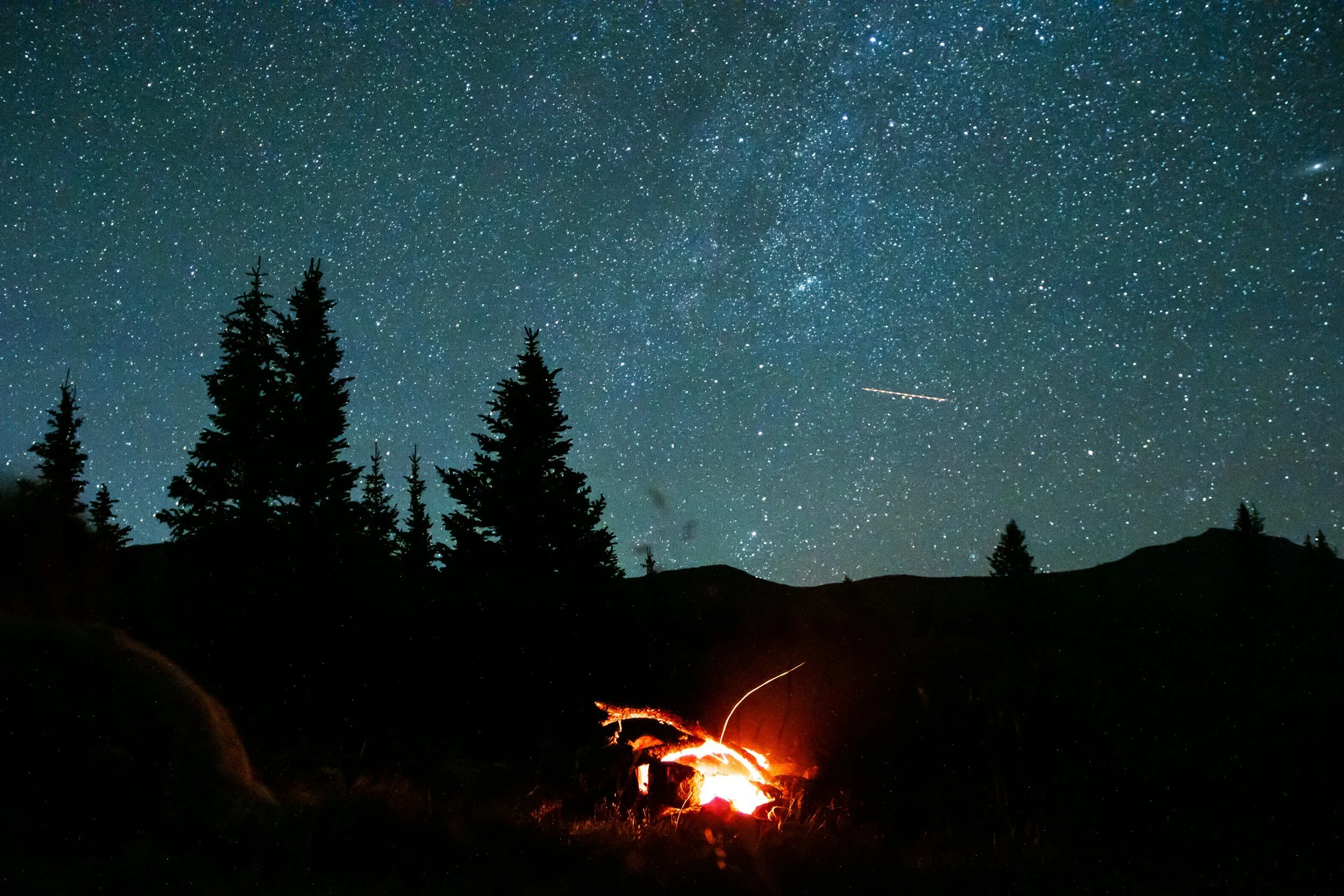
photo by Caleb Jack
Our eyes kept meeting across the campfire and I was transported to a different place and time. I was no longer a kid, a virgin, no longer awkward and afraid. I became that woman in the Robert Redford movie standing at the base of a snow-covered mountain wearing a full length fur coat and boots, my blonde hair wild, huge sunglasses, powerful and Swedish. Swedish women were meant to be very sexy in those days, much sexier than guilt ridden Irish girls. New Jersey fell away, my sad father, my worried mother, my reckless sister, horrible school, lost friends, lonely life wandering around trying to find a place. He was my place. He was my home. I remembered Wuthering Heights and whispered to myself “He is me.”
We climbed the White Mountains and canoed the Androscoggin River upstream from the paper mills that polluted the water. The mountains were a good change despite the physical demands. We dug out our hiking boots and since we were staying in the AMC huts we didn’t have to carry anything but a change of clothes. The mountain boys were college kids from Dartmouth and Williams and as Cindy pointed out, “so cute!” But I barely registered their flirting and when one of them asked me if I wanted to smoke a joint I declined only to watch Mitchell disappear with the same guy a few minutes later. I posed on boulders and watched the sunset trying to appear poetic and thoughtful which was challenging with nine fifteen year olds constantly expressing immature desires for things like s‘mores or yelling at squirrels because they never saw them in Brooklyn and feared they were rats.
Finally, we descended and ended up in a Maine town famous for lobsters. We had a beach picnic with beer and everyone else drank but Mitchell took my can away and whispered, “Come see me later.” After the others had gone to sleep I quietly unzipped our tent and walked across the campsite. There was a light inside his tent and when I bent down to whisper to him, he reached out and pulled me inside. “I was watching you in New York,” he said. “I couldn’t believe you were so beautiful and one of the campers.” “I’m not beautiful,” I said, barely breathing. He leaned forward and kissed my eyes, lips and cheeks. It felt wonderful, soft and sweet. “I want you,” he said, taking off my t-shirt. “I love you,” I said. “I’ve never had sex but that doesn’t matter. I want to marry you.”
He looked at me. “How old are you?” he asked in a choked voice. “Fifteen,“ I said. “And three months.” The tent flap opened, I was gently pushed out holding my shirt, my breasts naked to the night air. “Jailbait,” he murmured. “I’m sorry.” The campfire was completely out and there were beer cans scattered around the campsite. I sat down on a log next to the dead fire and sobbed. Cindy put her head out of our tent, saw me and whispered, “Come in here! Where have you been?” After I pulled a sweatshirt on and got into my sleeping bag I stopped shivering but there were still tears rolling down my face. “What happened?” Cindy demanded. “Did he hurt you?” “No,” I sobbed. “He called me ‘jailbait’ and threw me out.” “That stupid butt face!” This passed for swearing in Ohio. “He said I was beautiful,” I wailed. “But he wouldn’t have sex with me.” “You are beautiful,” Cindy said, pulling me into her arms. “You’re beautiful and smart and good and he’s a pathetic jerk who buys beer for minors.”
I knew she was right and I also knew she was the good one, the one who didn’t guard her trust and her love so jealousy. She was openhearted and sweet and funny and I should have said all those things to her before it was too late, before she left me standing by her coffin trying to tell her fiancée how much I loved her, trying not to slur my words or let on how soon I was planning to join her. She held me until I fell asleep and in the morning she treated Mitchell like dirt, refusing to answer his questions, glaring at him and, at one point, hitting him with her bicycle pump, pretending her aim was off. We had four days left before the end of the trip. Then I would take a bus to Maine to once again babysit the scion of a famous literary New York family. Cindy would fly home to her dull boyfriend and marching band. Mitchell treated me like a child; he was friendly, detached, condescending, and bossy. I was sulky and refused to cook anything. I rode my bicycle in a rage filled trance, unaware of the miles passing, listening to Cindy tell me over and over again how stupid and selfish and old he was while I decided to get rid of my virginity ASAP because clearly that was the problem.
The final night was scheduled in a hostel built by the WPA that had a huge dining room where we gathered after dinner and ended up playing a strange game that asked you to consider willing something to someone as if you were dead. A guy who was staying there who was about Mitchell’s age, long-haired and handsome, joined our small group. We invited him to share our meal. While I doubt I said more than three words to him he asked if he could leave me something. He said, “One dozen dead red roses for the girl with the broken heart.” Everyone looked from me to Mitchell who shrugged. The guy stood up, saluted us and walked away. Cindy put her arm around me and I buried my face in her shoulder. The rest of the group came and hugged me, their backs turned to Mitchell. I heard him leave and then Cindy whispered into my ear, “He’s gone now.”
–Molly Moynahan