Jersey Girl
“Exile is strangely compelling to think about, but terrible to experience. It is the unhealable rift forced between a human being and a native place, between the self and its true home: its essential sadness can never be surmounted. And while it is true that literature and history contain heroic, romantic, glorious, even triumphant episodes in an exile’s life, these are no more than efforts meant to overcome the crippling sorrow of estrangement.” ―Edward W. Said
I was heartbroken. I was a heartbroken hippie in half a sari given to me by a woman I met on the island of Corfu who, along with her boyfriend, had caught dysentery in India. They were both so emaciated that I could not imagine any travel experience worth the toll their bodies had paid. They appeared prematurely aged by their illness, squatting in the dust near the Taverna, their movements listless, their haunches ridiculously elongated and bony. Despite a plethora of seating possibilities, they seemed oblivious to their surroundings, eating bowls of white rice while the rest of us feasted on fresh feta and cucumbers, warm bread, and perfect coffee. “Tell your friends to eat,” the Taverna’s cook, Sophia, begged me. “They are so skinny!”
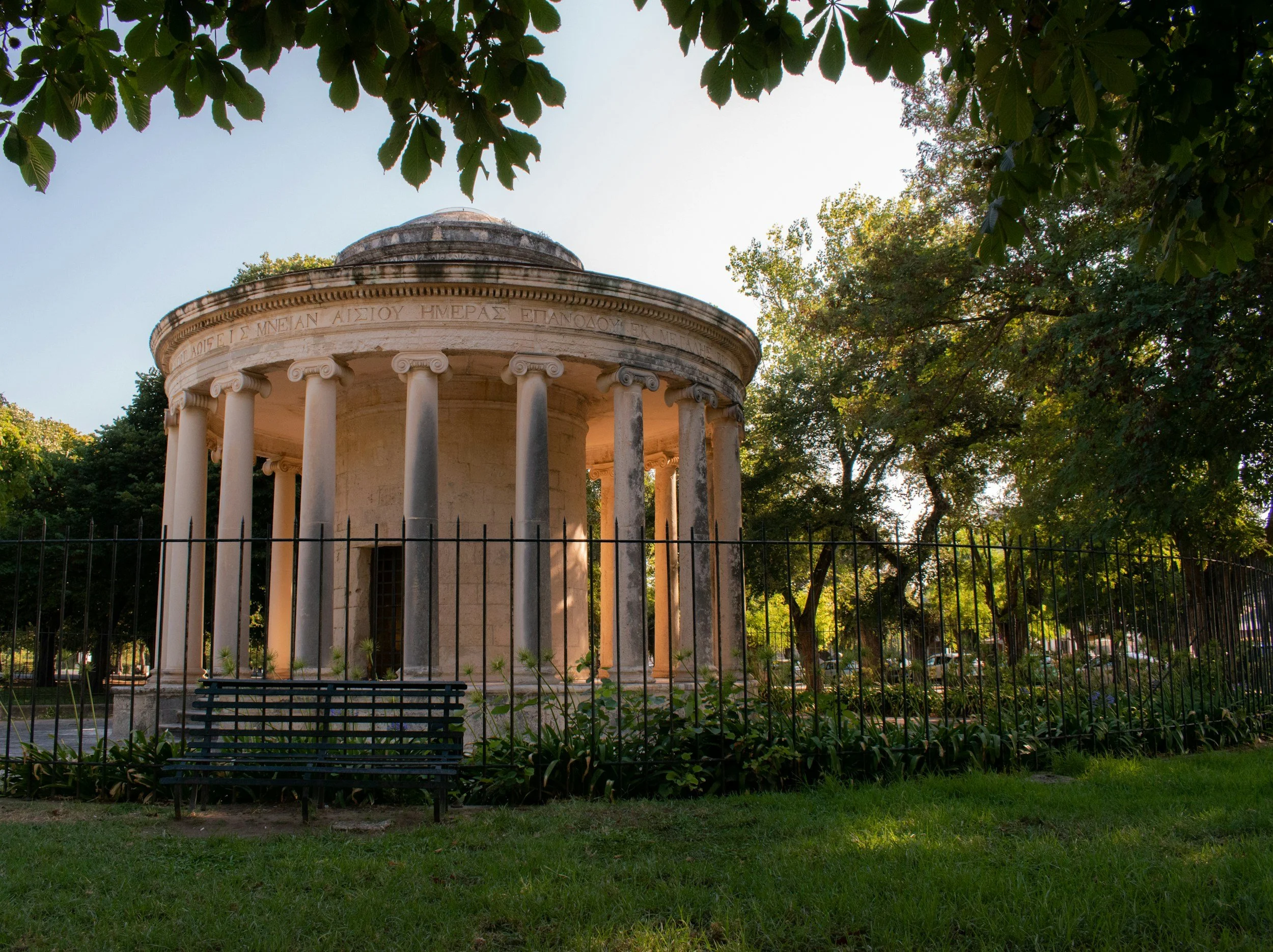
photo bt Corfu Diary
The couple was extremely rich. They had been on an extended worldwide trek for nearly two years, from Australia to Kathmandu, Africa to the Northern hemisphere. Their wealth had taken them off the track of the rest of us who clutched Eurorail passes and carried backpacks full of old clothes, Swiss army knives, and blocks of cheese. Compared to them, I was a rank amateur in the travel department. I had organized my itinerary around the train schedule offered by the Thomas Cook Group, a schedule printed in minuscule font that allowed a person to plan night trains to save money on a place to sleep and to visit the major European capitals on a budget.
By the time I arrived in Corfu, I had stayed in Vienna, Paris, Florence, and Venice, and for one unfortunate, sweltering night, Brindisi, Italy, where the ferry docked. In Brindisi, I had walked the gauntlet of Italian men who believed American girls would have sex with anything European. I was shocked by their behavior, sheltered despite my sophistication, which was a thin veneer, and my recent time abroad living in Dublin, attending Trinity College as a one-year student.
“Beautiful girl,” these men shouted. “Sit on my face!”
“American whore, I will pay for sex.”
“You have a lovely bosom,” a small boy muttered as he passed me on his bicycle. This was too much. I reached out and grabbed the saddle of his bike.
“Where do you live?” I screamed at this boy.
“Let me alone,” he yelled back, his face beginning to collapse into tears.
“I want to meet your parents,” I said. “Or I will take you to the police.”
So, we went to his house, and when a woman opened the door, I told her in the worst mix of Italian and English imaginable what her son had said to me.
“You go,” the woman said, “I will slap him.”
I nodded and proceeded down the street, my head held high. The child deserved to be slapped. But I was too sensitive. Love had come and gone, and I was leaving behind my life in Dublin, giving up on a man I could not change.
Denying my Yankee roots was never a possibility. While many of the other one-year students in Dublin immediately adopted a pseudo-Irish brogue (channeling Madonna?) I kept my modified New Jersey accent, shaped by growing up in Princeton, home of the perfect mid-Atlantic enunciation, a gift nearly obliterated by my freshman-year roommate, who spoke with the tortured tone of a girl who grew up in Elizabeth, New Jersey. Before The Sopranos made Jersey girls like Carmella cool, that accent was described as the verbal equivalent of fingernails scraping across a blackboard.
On my first home visit from Rutgers I told my mother that “Lisa and me were doin’ great and I was amazed to meet so many ‘genwine Jewish people’”
My mother stared at me.
“What?” I screeched.
“You can’t talk like that,” she finally said.
“I wasn’t being an anti-Semite,” I said. “I mean, kids in Princeton don’t act Jewish.”
“That’s not what I meant,” my mother said. “You can’t talk like that.”
“Really?”
I was thrilled. There were so few things left in the world to torture my parents with. My eldest sister had taken hard drugs, dated members of the Weather Underground, and gained too much weight. My next-eldest sister wanted to be an actress. While my first boyfriend had been a hippie loser he wasn’t a criminal. So, I dropped even more g’s and mispronounced every other word.
In Ireland, however, I devolved back to the clipped speech of my Princeton contemporaries, which was, in fact, my real speech pattern. Why was I so unmistakably American? Some of it was due to cosmetics. My teeth were shiny and straight, my skin spotless, and my hair shiny. These attributes were associated with American girls. Other mannerisms, my fast walk and my smiling were also considered “Yank.” Also, specifically, I spoke no language other than English, had the naïve belief that people were basically good, à la Anne Frank, and was woefully ignorant about any political situation, not only in the world outside of North America but in the world in general. I parroted my parents’ beliefs, liberal, progressive, pro civil rights, and women’s freedom, and based the rest on what I learned from reading Kafka and Vogue Magazine. I was an opinionated, ignorant American girl who would have been perfect for a Henry James novel with a shallow heroine. In short, I was confused and guilty, arrogant, and humiliated by my own ignorance.
And then I met him. I had been sleeping in the olive groves for nearly two weeks, waking up by myself while the rest of the taverna’s occupants traded partners like square dancers. But I wasn’t interested in any of the boys who arrived from the ferry. I had been reading too much, missing my Irish boyfriend, and writing in my journal about all the reasons I didn’t want to go back to the United States. I wasn’t in the mood for a fling. But he was different; older, at least in his late twenties, and he seemed to know Spiro, the taverna owner. While he was an American, he was very quiet and reserved. He was also stunningly handsome, tall and dark and graceful, and he moved unlike any of the men I’d known, more like a dancer than an athlete.
One night, he entered the taverna and sat down at my table. I was writing, but he didn’t say anything until I looked up.
“Let’s go see the moon,” he said.
I nodded.
The moon hung in the Corfu sky like a huge spotlight, everything washed in silver, the entire landscape illuminated. We sat in silence. I didn’t know what he wanted. Of course, he wanted something.
“I’m never going home,” he finally said. “I killed all these people in Vietnam, and I’m never going home.”
I saw the tattoo that had been hidden by his shirt sleeves. In those days, only pirates, Marines, or prostitutes had tattoos.
“I volunteered because my father was the mayor. I was eighteen, and I shot a woman with a baby. I thought she was trying to signal to the Viet Cong.”
I nodded. I didn’t know what to say. My best friend had been killed in a car crash the year before, a beautiful girl I loved very much. But I knew his sort of pain was beyond my understanding.
“I’m sick of Europe,” he said. “I just keep getting on planes and trains, and nowhere seems like a place to stay.”
“I like it here,” I said.
He looked at me and smiled. “Yes,” he said. “Corfu is perfect for pretty little hippie girls to disappear.” And then he pushed me down and kissed me.
In 1977 there was no AIDS, and most of us accepted how quickly physical intimacy could be established. We ate breakfast together, but we didn’t speak. I went to the beach, played with Spiro’s children, and had a conversation with some Australians, and then, right before midnight, he reappeared. “Let’s go,” he said. As if we had some sort of agreement. I followed.
We spent five nights together. First, he told me about Vietnam, and then we made love. It was the saddest sex I had ever experienced. I wanted to help him. My parents had been against the war, and I thought I could somehow obliterate the horrors he described to me, things I could barely stand to listen to, the massacring of babies, the old, civilians, and animals. I believed I had magical powers because I was young and hopeful. On the sixth morning, he came down with his backpack to say goodbye. “I won’t forget you,” he said. “I know you think I will, but I won’t.”
I called my parents from a pay phone that day and said I was coming home. It was mid-August, and I needed to get ready to go back to school in America. After all, I was a Jersey girl, and while I did not love everything about my native land, I was allowed to return, unlike my soldier, whose exile was permanent. As I stood at the dock waiting for the ferry to bring me back to Italy, I saw him. He was standing alone in the square, an American flag sewn to his jacket. I waved and smiled. He raised his hand to his temple and, like an ex-Marine, he saluted.
–Molly Moynahan